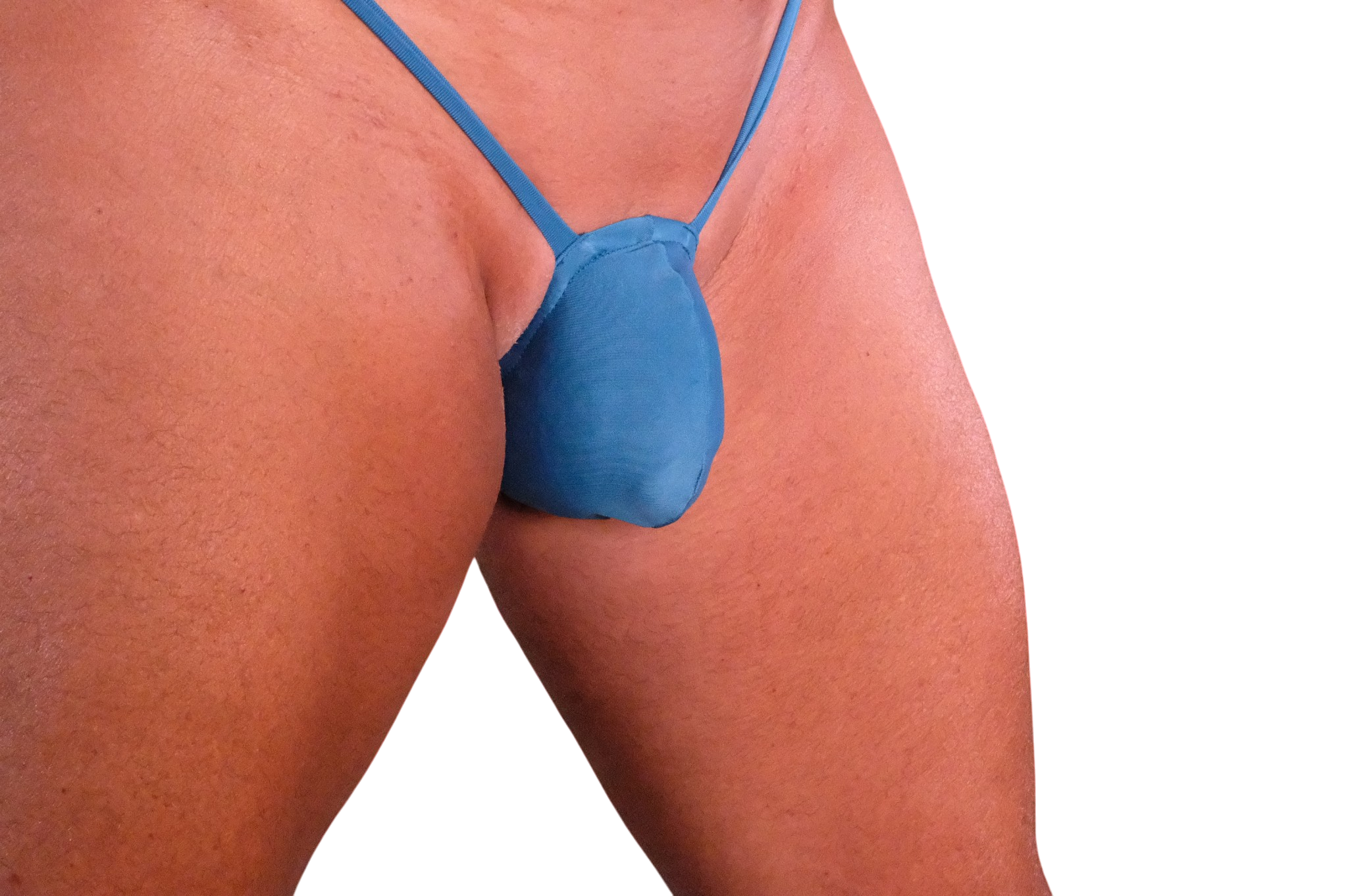
The History of Spandex Swimsuits for Men
Men’s swimwear has undergone an extraordinary transformation. What began as heavy, conservative bathing garments eventually evolved into streamlined racing briefs, bikinis, thongs, G-strings, and today’s remarkably small micro and ultra-micro swimsuits.
One material helped make much of that transformation possible: spandex.
The arrival of highly elastic synthetic fibers changed what a swimsuit could do. Instead of simply hanging from the body, swimwear could stretch around it, follow its contours, provide support, reduce excess fabric, and move naturally with the swimmer. For men in particular, this technological change helped create an entirely new category of body-conscious swimwear.
Today, men can choose everything from traditional swim briefs to bikinis, thongs, pouch suits, gender-fluid designs, and ultra-micro styles that would have been almost unimaginable during the first half of the twentieth century.
The history of men’s spandex swimsuits is therefore more than a history of fabric. It is also the story of changing attitudes toward the male body, masculinity, sexuality, athleticism, fashion, and personal freedom.
Before Spandex: When Men’s Swimsuits Covered the Body
Modern swimmers sometimes forget just how much fabric early men’s bathing suits contained.
During the nineteenth and early twentieth centuries, modesty standards strongly influenced bathing clothing. Men commonly wore garments covering much of the torso along with shorts or trunks. Wool was widely used because synthetic stretch fabrics did not yet exist.
These garments bear little resemblance to today’s swim briefs.
As social attitudes changed, men’s swimwear gradually became smaller. The male torso became increasingly acceptable to display, particularly as swimming developed into both a competitive sport and a popular recreational activity.
By the 1930s, topless swimming for men was becoming socially acceptable in the United States and elsewhere. Once the shirt disappeared, the basic modern concept of men’s swimwear emerged: a garment whose primary purpose was covering the lower body.
That was an enormous change.
But another revolution was still coming.
The Development of Spandex
Spandex was developed in the late 1950s as an extremely elastic synthetic fiber. It became widely associated with the trade name Lycra, introduced by DuPont.
The importance of this invention to clothing design is difficult to overstate.
Spandex could stretch dramatically and then return toward its original shape. When blended with materials such as nylon or polyester, it allowed manufacturers to produce lightweight garments that hugged the body while remaining flexible.
That combination was nearly perfect for swimwear.
A swimsuit could now fit tightly without requiring stiff construction. Designers could reduce the amount of fabric while maintaining a secure fit.
The material also allowed clothing to follow curves rather than merely covering them.
That distinction would profoundly influence men’s swimwear.
Competitive Swimming Helped Normalize Tight Men’s Swimwear
Long before tiny fashion bikinis became common for men, competitive swimmers were demonstrating the advantages of close-fitting swimwear.
Competitive swimming places a premium on freedom of movement and reducing unnecessary drag. Loose fabric is generally undesirable when speed matters.
This helped establish the fitted swimming brief as a legitimate athletic garment.
For generations of men, the swimming brief demonstrated something culturally important: a man could wear an extremely form-fitting garment in public without the garment automatically being considered feminine.
It was athletic equipment.
Swimmers, divers, water-polo players, and other aquatic athletes helped normalize the sight of the male body outlined by a close-fitting swimsuit.
That athletic foundation eventually provided fashion designers with somewhere to go.
The Speedo Era
No history of men’s brief-style swimwear would be complete without discussing the influence of Speedo-style racing briefs.
Although Speedo existed long before modern spandex became commonplace, the fitted racing brief became one of the most recognizable forms of men’s swimwear in the world.
Its importance extended far beyond competitive swimming.
The classic men’s swim brief established several ideas that seem ordinary today:
- Men’s swimsuits could be tight.
- Men’s thighs could be completely exposed.
- A swimsuit did not need long legs.
- The male anatomy did not have to be hidden beneath loose shorts.
- Minimal swimwear could be athletic rather than inherently provocative.
Those ideas created the foundation for virtually every smaller men’s swimsuit that followed.
The 1960s and 1970s: The Body Becomes Fashion
Western fashion changed dramatically during the 1960s and 1970s.
Clothing became more experimental, sexuality became more openly represented in popular culture, and traditional rules governing what men and women were supposed to wear began loosening.
At the same time, stretch fabrics were improving.
Men’s swimsuits became increasingly fitted, colorful, and fashion-oriented.
The swimsuit was no longer simply something a man wore because he needed clothing in the water. It could make a statement about his body and personality.
The growing fitness culture also mattered.
A man who spent time developing his physique increasingly wanted clothing that displayed it. A small swimsuit allowed the chest, stomach, hips, buttocks, and legs to remain visible.
Men’s swimwear was becoming bodywear.
The 1980s: Spandex Culture Explodes
The 1980s were arguably one of the defining decades for spandex.
Stretch clothing was everywhere.
Aerobics, bodybuilding, cycling, wrestling, dancewear, running clothing, leggings, tights, bodysuits, and brightly colored athletic apparel introduced millions of people to second-skin garments.
Men were increasingly surrounded by spandex.
Athletes wore it.
Cyclists wore it.
Wrestlers wore it.
Dancers wore it.
Bodybuilders and fitness enthusiasts embraced extremely revealing clothing.
This helped weaken the idea that close-fitting stretch clothing was exclusively feminine.
Swimwear designers could consequently experiment with higher leg openings, narrower sides, smaller backs, brighter colors, and more anatomically shaped fronts.
The male swimsuit was becoming increasingly sophisticated.
From Swim Brief to Men’s Bikini
One of the most important developments was the gradual distinction between a traditional swimming brief and a true men’s bikini.
The categories overlap, but fashion-oriented bikinis often feature:
- narrower sides,
- higher-cut legs,
- lower waistlines,
- smaller rear coverage,
- more sculpted front pouches,
- softer and lighter construction.
This represented an important philosophical change.
Traditional swim briefs were heavily influenced by athletics. Men’s bikinis could exist primarily because they looked attractive.
Men were beginning to choose minimal swimwear for exactly the same reason women had long chosen bikinis: fashion, tanning, body confidence, comfort, and sex appeal.
Gay Beach Culture and Men’s Swimwear
Gay men played an important role in the development and popularization of body-conscious men’s swimwear.
Gay beaches, resorts, cruises, pool parties, and nightlife environments provided spaces where men could experiment with styles that might initially have seemed too adventurous for mainstream beaches.
Bikinis became smaller.
Thongs appeared.
G-strings became viable swimwear.
Sheer and semi-sheer materials appeared.
Pouches became increasingly anatomical.
The male body itself became part of the design.
Gay men’s fashion helped demonstrate that there was a substantial market for men who did not want swim trunks designed to disguise their bodies.
Over time, many styles once associated primarily with gay resort culture began appearing among a much broader range of men.
The Rise of Men’s Thong Swimwear
The thong represented another major step.
Instead of merely reducing the sides of a swimsuit, designers dramatically reduced the rear.
This made the buttocks a visible part of men’s beach fashion.
Initially, men’s thong swimwear was provocative almost by definition. It challenged conventional assumptions about what men should reveal.
But the same had once been true of men’s briefs.
As thongs became more familiar, their audience expanded. Men discovered practical reasons for wearing them as well: excellent tanning, minimal wet fabric, freedom of movement, and an unmistakably body-conscious appearance.
The thong also opened the door to even smaller designs.
The G-String Takes Minimalism Further
A men’s G-string asks a simple design question:
How much material does a swimsuit actually need?
The answer can be surprisingly little.
A small front pouch can provide the essential coverage while strings around the hips and between the buttocks keep the garment in position.
Spandex makes this possible because the front can stretch and conform to the wearer’s anatomy without requiring large amounts of material.
The G-string therefore represents one of the purest expressions of stretch-fabric swimwear.
Every piece of fabric has a purpose.
Everything unnecessary disappears.
The Pouch Revolution
Perhaps the greatest difference between modern men’s spandex swimwear and older men’s swimsuits is the development of the pouch.
Early trunks essentially provided an area of fabric in front of the body.
Modern designs can actually be engineered around male anatomy.
Different pouch constructions can create dramatically different appearances.
Some compress.
Some support.
Some lift.
Some minimize.
Others emphasize the natural outline.
Contoured and anatomical pouches can allow the swimsuit to follow the shape of the wearer rather than flattening everything behind a conventional front panel.
This development helped create a new philosophy:
Instead of pretending male anatomy isn’t there, why not design the swimsuit around it?
That concept has become especially important in micro swimwear.
Men’s Micro Swimsuits Arrive
Once designers had stretch fabrics, sophisticated pouch construction, narrow sides, and reduced rear coverage, the next logical step was the micro swimsuit.
Micro swimwear takes the bikini concept and reduces it further.
The objective isn’t simply showing more skin. Good micro design requires surprisingly careful engineering.
As coverage decreases, fit becomes increasingly important.
A large swimsuit has room for error.
A micro swimsuit does not.
The pouch must stretch appropriately. Straps must remain positioned correctly. The garment must accommodate movement. Every millimeter of material begins to matter.
That is one reason spandex is so important to the category.
Stretch is what allows tiny garments to remain functional.
Ultra-Micro Swimwear Pushes the Boundary
The development of ultra-micro swimwear has taken minimalism even further.
These suits may feature extremely narrow fronts, tiny anatomical pouches, minimal straps, or highly reduced backs.
Some are essentially pouch-only swimsuits.
From a historical perspective, that is remarkable.
Compare a torso-covering men’s bathing costume from the early twentieth century with a twenty-first-century pouch swimsuit.
They barely appear to belong to the same category of clothing.
Yet one evolved from the other.
The history of men’s swimwear has largely been a history of removing material.
Pouch-Only Men’s Swimwear
Pouch-only swimwear represents one of the most extreme expressions of this trend.
The basic idea is simple: provide secure coverage where coverage is necessary while leaving nearly everything else exposed.
Instead of asking how small a conventional bikini can become, pouch-only design begins with the anatomy and builds the minimum garment necessary around it.
The result can approach the visual sensation of nudity while technically remaining swimwear where applicable rules permit it.
These designs demonstrate just how far stretch-fabric engineering has progressed.
Men’s Swimwear and the Changing Attitude Toward the Penis
For much of modern fashion history, men’s clothing has had an uneasy relationship with visible anatomy.
Traditional clothing often attempted to disguise the shape of the genitals.
Spandex made that increasingly difficult—and eventually designers stopped necessarily viewing that as a problem.
A close-fitting swimsuit naturally reveals body contours.
Contemporary men’s swimwear can take several completely different approaches to this reality.
Some designs minimize the bulge.
Others create a smooth neutral front.
Some emphasize the pouch.
Others produce a very anatomical appearance.
The important change is choice.
Men are no longer restricted to one culturally approved silhouette.
The Micro-Bulge Movement
Interestingly, not every revealing swimsuit is designed to make the wearer appear larger.
Some men deliberately prefer a very compact front.
Micro-bulge suits use compression, compact pouch construction, or minimal styling to create a smaller silhouette.
This illustrates how sophisticated men’s swimsuit fashion has become.
The goal is no longer universally “make the bulge bigger.”
One man may want enhancement.
Another wants natural definition.
Another wants compression.
Another wants almost no visible bulge at all.
Spandex can accommodate all of them.
Gender-Neutral Swimwear Changes the Conversation
Another major development has been the weakening of traditional gender boundaries in swimwear.
Historically, men’s and women’s swimsuits occupied very different categories.
That distinction is becoming less absolute.
Men now wear bikinis, thongs, G-strings, high-leg designs, bright colors, and silhouettes once marketed almost exclusively toward women.
At the same time, gender-neutral and gender-fluid swimwear has created another possibility: the swimsuit does not necessarily have to announce male or female at all.
For some wearers, that freedom is the entire point.
MTF and Feminizing Swimwear
Stretch-fabric technology has also made specialized feminizing swimwear possible for transgender women, nonbinary people, femboys, crossdressers, and other people who want a more feminine silhouette.
Rather than emphasizing male anatomy, these designs may attempt to smooth or reshape the front.
Tucking-compatible swimsuits can help hold the anatomy in a flatter position. Specialized shaping garments can create an even smoother profile.
This represents almost the opposite philosophy from anatomical pouch swimwear.
One style says:
Show the male anatomy.
Another says:
Minimize it.
Modern stretch fabrics make both approaches possible.
Men’s and Women’s Swimwear Begin to Converge
For much of the twentieth century, the difference was obvious.
Women wore one-piece swimsuits and bikinis.
Men wore trunks or briefs.
Today those categories are increasingly blurred.
A men’s swimsuit can feature:
high-cut legs, tiny sides, cheeky backs, thong backs, G-string construction, string ties, bright colors, prints, metallic fabrics, sheer panels, or extremely minimal coverage.
These features are no longer inherently male or female.
They are simply design choices.
That may ultimately prove to be one of the most important developments in the history of men’s swimwear.
Board Shorts Dominated—and Briefs Survived
The evolution toward smaller swimwear was not perfectly linear.
During the 1990s and 2000s, long board shorts became enormously influential, particularly in American beach culture.
For many men, swimwear became larger again.
Surf culture helped popularize loose shorts extending toward or below the knee.
Yet fitted swimwear never disappeared.
Competitive swimmers continued wearing streamlined suits. Briefs remained common in many parts of Europe and elsewhere. Gay resort culture continued developing minimal designs. Fashion brands continued producing fitted men’s swimwear.
Eventually, men’s fashion began diversifying again.
The important modern change isn’t necessarily that every man is abandoning shorts.
It is that shorts are no longer the only socially imaginable choice.
Social Media Changes Men’s Swimwear Fashion
The internet dramatically accelerated fashion experimentation.
Before social media, a man might only see what other men were wearing at his local beach.
Today he can instantly see beachwear from Ibiza, Mykonos, Miami, Rio de Janeiro, Sydney, Los Angeles, Barcelona, or countless resort destinations.
He can discover:
swim briefs, Brazilian cuts, bikinis, thongs, G-strings, micros, pouch suits, sheer designs, gender-fluid styles, and specialized transformation swimwear.
Niche fashion no longer has to remain local.
That has allowed extremely specialized swimsuit categories to find worldwide audiences.
The Psychological Shift May Be Bigger Than the Fashion Shift
Perhaps the biggest change has happened in men’s minds.
For generations, many boys were taught that men’s swimwear should be loose and concealing.
That expectation can become deeply ingrained.
The first time a man changes from board shorts to a fitted swim brief can therefore feel surprisingly significant.
Then the brief becomes normal.
A bikini becomes imaginable.
A thong becomes possible.
A micro swimsuit may eventually stop seeming particularly radical.
This pattern illustrates an important feature of clothing psychology: familiarity changes perception.
What feels shocking the first time can eventually feel completely ordinary.
Why Men Choose Smaller Spandex Swimsuits
Modern men choose minimal swimwear for many different reasons.
Some want better tanning.
Some dislike swimming in loose shorts.
Some have athletic physiques they enjoy displaying.
Some like the feel of spandex.
Some enjoy fashion experimentation.
Some want a sexier appearance.
Some prefer emphasizing their anatomy.
Others prefer minimizing it.
Some enjoy feminine styling.
Some simply discover that a tiny swimsuit is surprisingly comfortable.
There is no single “type” of man who wears one.
That diversity itself represents progress.
From Wool to Ultra-Micro
Consider the entire journey.
Men’s bathing fashion moved from heavy garments covering much of the body to trunks.
Trunks became shorter.
Athletic briefs emerged.
Stretch fabrics improved the fit.
Briefs became bikinis.
Bikinis became thongs.
Thongs became G-strings.
Micro bikinis reduced coverage further.
Pouch technology became increasingly sophisticated.
Gender-neutral and feminizing designs challenged the traditional male silhouette.
Pouch-only suits pushed minimalism close to its practical limit.
More than a century of swimwear development can almost be summarized with one question:
How much fabric does a man really need to go swimming?
Designers keep finding smaller answers.
Spandex Created Freedom Through Fit
The importance of spandex goes beyond revealing more skin.
Its greatest contribution is versatility.
The same basic technology can produce a conservative swim brief, athletic racing suit, Brazilian bikini, compression suit, thong, G-string, micro bikini, anatomical pouch, smoothing swimsuit, or gender-fluid design.
That means the modern male swimmer has something previous generations rarely possessed:
choice.
He can decide how much of his body to reveal.
He can decide whether his swimsuit looks masculine, feminine, neutral, athletic, sexy, conservative, or extreme.
He can decide whether the front emphasizes, naturally follows, minimizes, or smooths his anatomy.
The swimsuit adapts to the wearer rather than forcing every wearer into the same style.
The Future of Men’s Spandex Swimwear
The history suggests that experimentation will continue.
Future developments are likely to involve even lighter fabrics, improved stretch and recovery, seamless construction, advanced pouch engineering, better compression systems, sustainable fibers, customized sizing, and designs that increasingly ignore traditional gender categories.
Micro swimwear will probably continue evolving as well.
There is a practical limit to how much material can be removed while maintaining coverage, but designers can continue experimenting with how that minimal material is shaped and supported.
The next revolution may therefore involve engineering rather than simply shrinking.
From Hiding the Male Body to Celebrating Choice
The history of men’s spandex swimsuits reflects a much larger cultural transformation.
Men once swam in garments designed largely around modesty.
Athletic culture helped normalize the exposed male torso.
Competitive swim briefs normalized tight-fitting bottoms.
Spandex allowed swimsuits to become smaller and more precisely fitted.
Bikinis transformed minimal men’s swimwear into fashion.
Gay beach and resort culture helped push boundaries.
Thongs and G-strings dramatically reduced coverage.
Micro and ultra-micro suits pushed minimalism toward its practical limits.
Anatomical pouches celebrated the male form, while gender-neutral and feminizing designs demonstrated that a swimsuit could also reshape or deemphasize it.
The result is the extraordinarily diverse men’s swimwear market we have today.
A man can wear board shorts if he loves them.
He can wear a classic racing brief.
He can wear a bikini.
He can wear a thong.
He can wear a G-string.
He can choose a micro swimsuit with just enough fabric to provide coverage.
And increasingly, none of these choices has to define his masculinity, sexuality, or identity.
That may be the most important chapter in the history of men’s spandex swimwear.
The evolution isn’t simply from larger swimsuits to smaller ones. It is the evolution from rules toward choice.
And spandex helped make that freedom possible.